






































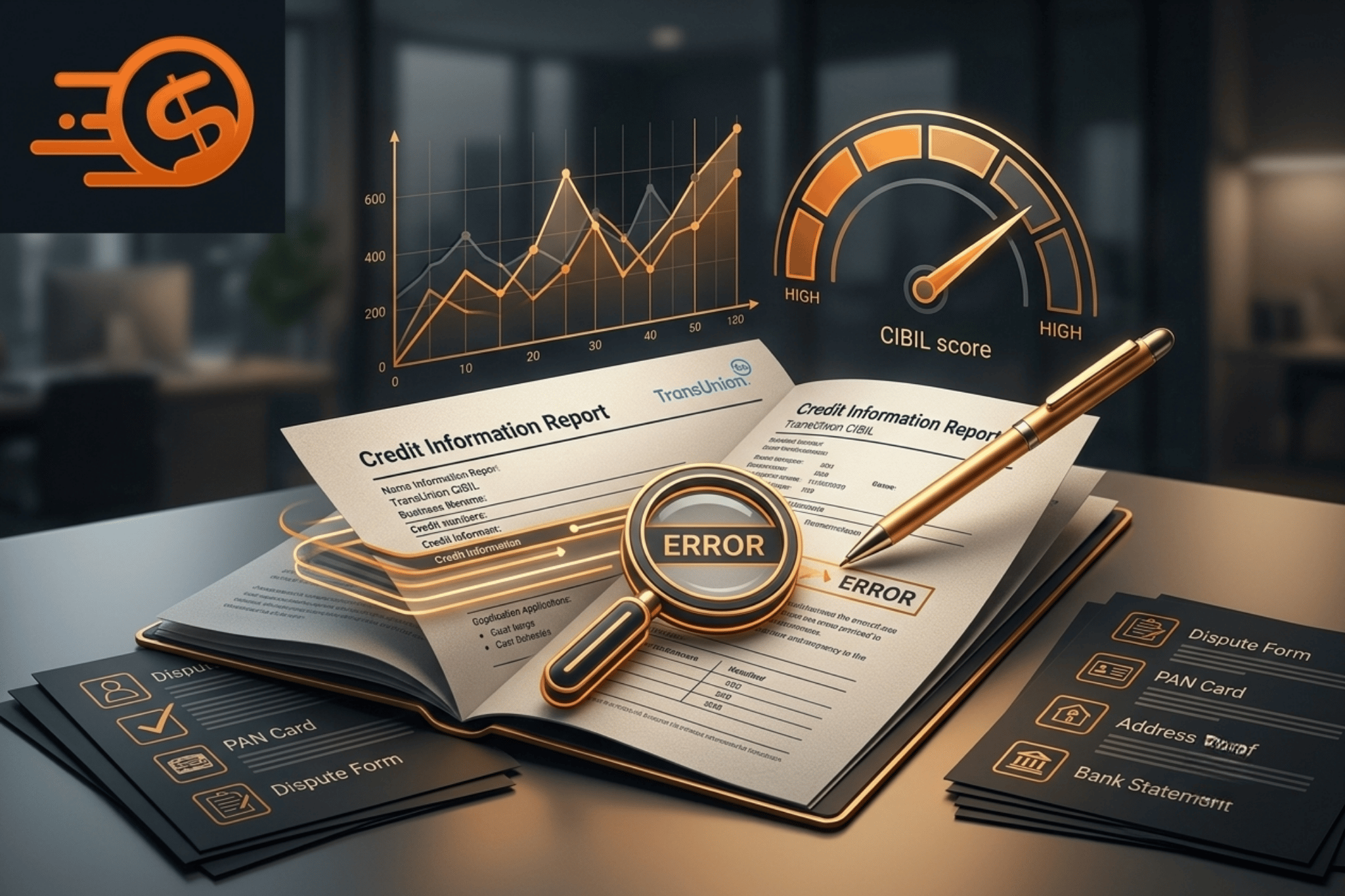

A CIBIL report can look like a simple financial document, but a single incorrect entry can create a surprisingly big problem. Imagine preparing to apply for a home loan, business loan, or credit card, only to find an unfamiliar account, an incorrect overdue amount, or a loan marked as “settled” when you actually closed it properly.
That is when knowing how to fix CIBIL report errors becomes important.
The good news is that an incorrect entry does not have to remain on your credit report forever. You can raise a dispute with TransUnion CIBIL and, where appropriate, contact the bank or financial institution that supplied the information. CIBIL says disputes generally take approximately 30 days to resolve, subject to the response time of the concerned credit institution.
It is also important to understand one point from the beginning: CIBIL does not independently rewrite information reported by lenders. Corrections normally depend on confirmation from the concerned bank or financial institution.
Financial Planning and Credit Report Accuracy
Good financial planning is not only about saving, investing, or managing cash flow. Your credit history can also influence how smoothly you access borrowing when an important financial goal arrives.

Why Financial Planning Depends on Accurate Credit Reports
Suppose you are building a financial plan to purchase a property, expand a business, finance equipment, or manage working capital. You may have sufficient income and a reasonable repayment history, but an inaccurate credit report can still complicate the application process.
A lender may review your credit information while assessing your application. If the report contains incorrect personal details, duplicate accounts, inaccurate payment information, or an account that does not belong to you, it is sensible to address the error before making a major borrowing decision.
That is why checking your CIBIL report periodically should be treated as part of responsible financial planning rather than something you do only after a loan application is rejected.
CIBIL itself recommends regularly reviewing your credit history and notes that checking your own CIBIL Score does not reduce it.
Common CIBIL Report Errors That Affect Loan Eligibility
Not every negative-looking entry is an error. Before raising a dispute, compare the information in your report with your loan statements, repayment records, closure letters, and other documents.
Some common problems include:
Wrong Personal Information
Your name, address, PAN-linked information, employment details, or other personal information may be displayed incorrectly.
A spelling variation is not necessarily a credit-report error, but information that genuinely belongs to another person or materially misrepresents your identity should be investigated.
Incorrect Loan Status or Duplicate Entries
Sometimes an account may appear more than once, or a loan may show an incorrect outstanding balance or status.
For example, you may have already repaid an account, while the report continues to show an outstanding amount. A duplicate account can also make your overall credit exposure appear higher than it actually is.
CIBIL allows consumers to dispute inaccuracies across areas such as personal information, contact information, employment information, account details, and enquiries.
Settled or Written-Off Accounts Misreported
This is one of the areas where caution matters most.
A “settled” or “written-off” status should not simply be removed because it looks negative. If the lender has correctly reported the account status, a dispute does not automatically erase it.
However, if the status, balance, payment history, or ownership is genuinely incorrect, you can challenge the information with supporting evidence and ask the reporting institution to verify it.
How to Raise a Dispute in CIBIL Report
The process is relatively straightforward when you have identified the exact information that appears to be wrong.
CIBIL currently provides an online dispute facility through its consumer dispute process.
Step-by-Step Online Process (2026 Update)
A practical process looks like this:
- Obtain and review your CIBIL Report.
- Identify the exact inaccurate entry rather than disputing information generally.
- Log in to your CIBIL account and access the credit-report section.
- Navigate to the dispute option for the relevant information.
- Select the field or account you believe is inaccurate.
- Provide the appropriate explanation and supporting information.
- Submit the dispute and retain the reference details.
- Track the dispute status and monitor your registered email for updates.
CIBIL states that disputed fields may be marked “Under Dispute” while the matter is being investigated.
You can also approach the relevant bank or financial institution directly, particularly when you already have documentation proving that its information is inaccurate.
Required Documents for Dispute Filing
There is no universal document bundle that applies to every dispute. The right evidence depends on what you are challenging.
Depending on the issue, useful documents may include:
- Loan closure or no-dues certificate
- Bank statements showing repayments
- Credit-card statements
- Loan sanction or account documents
- Payment receipts
- Relevant correspondence with the lender
- Identity or address documents where personal information is incorrect
- Documents demonstrating that an account or enquiry does not belong to you
The principle is simple: make the dispute specific and support it with evidence wherever possible.
Can CIBIL Directly Change Report Details?
Generally, no.
CIBIL is a credit information company, but it does not independently decide that a lender’s account information should be changed. CIBIL states that it cannot directly change or delete information in a credit report without confirmation from the concerned credit institution.
So, if your lender has reported an incorrect outstanding balance, the practical route is usually to raise the dispute and allow the lender to verify its records.
How Long Does a CIBIL Dispute Take?
This is where many consumers become confused because two different timelines are often discussed.
CIBIL states that a dispute may take approximately 30 days to resolve, depending on the time taken by the concerned credit institution.
Separately, CIBIL notes that credit institutions generally submit information every 30–45 days, which can affect when a normal account update appears in a report. That reporting cycle should not be confused with the formal dispute-resolution timeline.
Typical Turnaround Time (30–45 Days)
For an actual dispute, plan around the formal 30-day resolution framework, rather than assuming every correction will take 30–45 days.
Under the RBI framework, the overall limit for resolving a credit-information complaint is 30 calendar days. The concerned credit institution has up to 21 days, with the credit information company effectively having the remaining nine days.
So, 30 days is the more relevant benchmark for a dispute, while 30–45 days can relate to the normal reporting cycle for credit information.
Fastest Resolution Scenarios
A dispute may move more smoothly when:
- The error is clearly identifiable.
- The lender can quickly verify its records.
- Your supporting documents are complete.
- The account details you provide match the lender’s records.
- There is no complicated ownership or identity issue.
There is no legitimate way to guarantee that a CIBIL error will be corrected “overnight.” Anyone promising guaranteed instant removal of accurate negative information should be approached cautiously.
What If Dispute Is Rejected or Unresolved?
First, read the reason for rejection carefully.
If the information is genuinely incorrect, contact the concerned lender or financial institution with the relevant evidence and request correction in its records. You can then pursue the appropriate CIBIL dispute process again based on the verified information.
If a complaint is not resolved within the applicable 30-day framework, RBI’s compensation framework provides for ₹100 per calendar day of delay, subject to the framework’s conditions.
For grievances against regulated entities, the RBI’s current Reserve Bank–Integrated Ombudsman Scheme, 2026 also provides a cost-free alternate grievance-redress mechanism after the required prior complaint process has been followed. The 2026 scheme came into force on July 1, 2026.
Is There Any Fee to File a CIBIL Dispute Online?
Consumers do not need to pay a fee simply to correct inaccuracies or update incorrect credit information. CIBIL specifically states that consumers are not required to pay a fee for rectifying discrepancies or updating credit information.
Be especially careful if someone approaches you claiming that they can pay CIBIL to delete a genuine default, settled account, or negative history. Accurate credit information cannot legitimately be removed merely because someone pays a third party.
Fast Ways to Fix Credit Report Errors
The fastest legitimate approach is usually the one that reaches the correct source of the information with clear evidence.
Online Dispute Portal
If the error appears in your CIBIL Report, use the official CIBIL dispute process and identify the precise field or account that needs verification.
CIBIL allows multiple fields or information types to be disputed through its online process.
Contacting Lenders Directly
If the error clearly originates from a bank, NBFC, or other credit institution, contacting that institution can be equally important.
Ask the lender to investigate the underlying account records and, where appropriate, send corrected information to the credit information company.
Keep copies of your complaint, acknowledgement, emails, statements, and supporting documents. They can become valuable if you need to escalate the matter later.
Escalation to RBI Ombudsman
The RBI Ombudsman should not be treated as the first step.
Generally, you should first complain to the concerned regulated entity. Under the current RBI framework, you may approach the RBI Ombudsman when the regulated entity does not respond within the applicable period or when you are dissatisfied with its response or resolution, subject to the scheme’s requirements.
For credit-information complaints, it is therefore sensible to maintain a clear paper trail: dispute raised → lender/CIBIL response → supporting evidence → escalation, if necessary.
Realistic Timelines to Improve Credit Score in India
Fixing a CIBIL report error and improving a genuine low credit score are two different tasks.
If your score is being affected by inaccurate information, correcting the error may help once the corrected data is reflected. But if the information is accurate, there is no legitimate “quick delete” button.
Improving credit health generally requires consistent repayment behaviour over time.
Can Credit Score Increase in 1 Month?
It can, but there is no guaranteed number of points by which a score will increase.
If a significant reporting error is corrected, your score could potentially change after the corrected information is reflected. Otherwise, one month is usually too short to expect a dramatic improvement from normal credit-management activities.
The better goal is to create a clean repayment pattern rather than chase a specific score increase by a particular date.
How Much Can a Credit Score Increase in 3 Months?
There is no universal answer.
The effect depends on your existing credit history, repayment behaviour, utilisation, outstanding balances, recent applications, account age, and the information being reported by lenders.
For some consumers, reducing high credit-card utilisation and maintaining timely payments may help over subsequent reporting cycles. For others, meaningful improvement may take considerably longer.
Is There a Fast Way to Improve Credit Score in India? (30–90 Day Plan)
A practical 30–90 day approach can focus on fundamentals:
Days 1–30:
Check your credit reports, identify genuine errors, raise disputes, and ensure all current EMIs and credit-card bills are paid on time.
Days 31–60:
Keep credit-card utilisation under control, avoid unnecessary new credit applications, and follow up on unresolved disputes.
Days 61–90:
Review the updated report, confirm that corrected information has been reflected, and continue maintaining consistent repayment behaviour.
The objective is not to manufacture a quick score increase. It is to build a credit profile that remains healthy after the immediate loan requirement has passed.
Will Paying Off Credit Cards Immediately Improve My Credit Score?
Not necessarily immediately.
Paying outstanding balances can improve your overall financial position and may affect credit utilisation, but the score change depends on several factors and when updated information reaches the credit bureau.
CIBIL notes that credit institutions submit information periodically, so a repayment made today may not necessarily appear in the report immediately.
Also remember that paying a genuine debt does not mean every historical negative entry disappears instantly. Accurate repayment history remains part of your credit record according to applicable reporting practices.
Does Raising a CIBIL Dispute Affect or Lower My Credit Score?
Simply raising a dispute does not mean your CIBIL Score will automatically fall.
CIBIL’s process marks relevant disputed information as “Under Dispute” while the matter is being investigated.
The important point is to dispute information because you genuinely believe it is inaccurate—not simply because you dislike a legitimate entry on your report.
Partner with Real Wealth Business – Your Trusted Financial Advisor in India
Financial decisions rarely happen in isolation. A credit report issue may appear small today, but it can become important when you are planning a home purchase, business expansion, new borrowing, investment, or a major financial commitment.
At Real Wealth Business, the goal is to help readers approach financial decisions with greater clarity—from understanding credit and borrowing decisions to building stronger financial planning habits.
Why Choose Real Wealth Business for Financial Planning
Financial planning should be practical, informed, and connected to real-life goals.
Whether you are preparing for a major purchase, managing business finances, evaluating borrowing options, or trying to build healthier financial habits, the right information can help you make decisions with greater confidence.
Expert Guidance on Credit Reports, Loans, and Banking Decisions
A credit report should be viewed as one component of a broader financial picture.
Understanding what your CIBIL report says, identifying genuine inaccuracies, knowing when to approach a lender, and understanding the appropriate escalation route can help you avoid unnecessary delays and financial confusion.
Collaboration Opportunities – Guest Articles, Advisory, and Insights
Real Wealth Business also brings together business, finance, and growth-focused insights for entrepreneurs, professionals, and modern business owners.
Through informative articles, expert perspectives, advisory-focused insights, and relevant collaborations, the platform aims to make complex financial and business topics easier to understand and apply.
Take the Next Step Toward Smarter Financial Planning
If you have found an error in your CIBIL Report, do not panic—and do not pay anyone who promises an instant removal of accurate negative information.
Start with the facts. Review the report carefully, collect the right documents, raise a formal dispute, contact the reporting lender where necessary, and keep a record of every communication.
And when your credit issue is part of a bigger financial decision, Real Wealth Business can help you approach financial planning with greater clarity, confidence, and long-term perspective.
Reach out to Real Wealth Business today to strengthen your financial planning and make smarter decisions about credit, loans, and business growth.
Editorial note: This article is for educational purposes and should not be treated as legal, banking, or personalised financial advice. CIBIL and RBI processes can change, so readers should verify current requirements with the relevant institution before taking action.