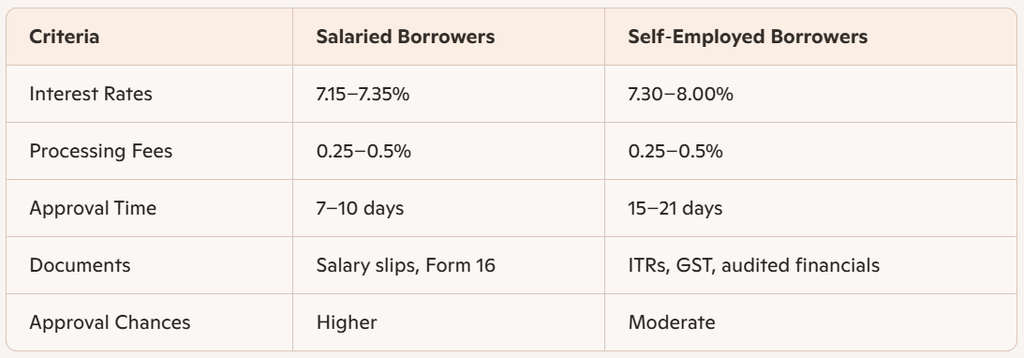








































For entrepreneurs and salaried professionals alike, securing a home loan in India is a critical step in financial planning. Yet, lenders evaluate these two borrower categories differently — impacting interest rates, processing fees, documentation and approval timelines.
If you receive a regular monthly salary, your income may be relatively straightforward for a lender to verify. If you run a business, work as a freelancer or earn through multiple professional sources, your income may require a deeper financial assessment. This does not mean that self-employed applicants cannot secure competitive home loans. It simply means that preparation matters more.
Understanding how lenders compare salaried and self-employed borrowers can help you choose the right loan, prepare stronger documents and make a borrowing decision that fits your long-term financial goals.
Home Loan Eligibility Beyond Employment Type
Employment status is only one part of a lender’s decision. Your age, income, credit history, existing financial commitments, business stability and repayment capacity can all influence your home loan eligibility.
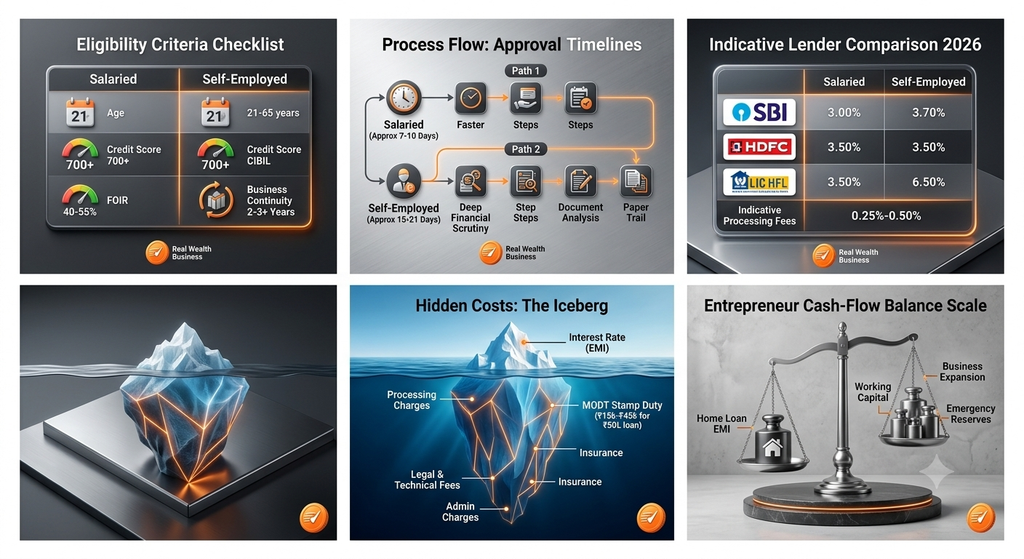
For many borrowers in 2026, important eligibility factors may include:
- Age: Generally around 21–65 years, although some lenders may allow repayment up to 70 depending on their policies.
- Income: Lenders assess whether your regular income is sufficient to support the proposed EMI and existing obligations.
- Business continuity: Self-employed applicants may generally need around 2–3 or more years of established business or professional continuity.
- Credit profile: A CIBIL score of 700+ can strengthen an application, while scores around 725–750 or higher may help borrowers qualify for more competitive offers, subject to lender policy.
- FOIR: Fixed Obligation to Income Ratio commonly falls within a broad range of around 40–55%, depending on the lender and applicant profile.
- Existing debt: Personal loans, credit-card balances, vehicle loans and other EMIs can reduce your available borrowing capacity.
Salaried Borrowers May Receive Faster Verification
For salaried applicants, income verification can be relatively simple because salary slips, Form 16 and bank statements provide a consistent record of earnings.
This predictable cash flow can make the assessment process easier. Some lenders may process straightforward salaried applications within approximately 7–10 days, although the actual timeline depends on documentation, property verification, credit checks and internal approval procedures.
Self-Employed Borrowers Face Deeper Financial Scrutiny
For a self-employed applicant, income can fluctuate from month to month or year to year. Lenders therefore tend to examine the applicant’s overall financial picture rather than relying on one monthly income figure.
Depending on the applicant and lender, this may include:
- Income Tax Returns
- GST returns
- Profit and loss statements
- Balance sheets or audited financial statements
- Business registration and continuity documents
- Bank statements
- Existing loan details
- Proof of business or professional activity
The additional verification can make the process longer. Some lenders may take around 15–21 days for more complex self-employed applications, but the timeline varies considerably.
Who has a better chance of getting a home loan: salaried or self-employed?
Salaried borrowers may have an advantage because their income is generally easier to verify and more predictable. However, self-employed applicants with stable businesses, consistent ITRs, healthy banking records and strong credit profiles can also have good approval prospects.
Yes. Self-employed professionals and business owners can apply for home loans in India. The key difference is that lenders generally require more detailed evidence of income, business continuity and repayment capacity before approving the application.
Interest Rates Comparison: 2026 Data
Interest rates can differ according to the lender, loan amount, credit score, employment profile, relationship with the lender and other risk factors. Based on the comparison in this article, indicative rates are:
| Lender | Salaried Borrower | Self-Employed Borrower |
|---|---|---|
| SBI | 7.15% | 7.35–7.75% |
| HDFC | 7.35% | 7.60–8.00% |
| LIC HFL | 7.25% | 7.30–7.75% |
These figures should be treated as indicative rather than guaranteed offers. Actual rates can change and should be confirmed directly with the lender before making a borrowing decision.
In many cases, self-employed borrowers may face a rate difference of approximately 0.25–0.50% because variable or less predictable income can be perceived as carrying additional repayment risk.
They can be. Self-employed applicants may sometimes receive slightly higher rates than comparable salaried applicants because lenders may consider their income less predictable. However, a strong credit score, consistent income, healthy business financials and a good repayment record can improve the overall loan offer.
Processing Fees, Approval Time and Hidden Costs
Interest rate is important, but it should not be the only number you compare.
A home loan can involve processing charges, legal and technical verification costs, documentation expenses, mortgage-related charges, insurance and applicable government duties. Looking only at the advertised interest rate could therefore give you an incomplete picture of the actual borrowing cost.
Indicative processing charges in the comparison include:
- SBI: Around 0.35%, subject to the applicable maximum charge and lender terms.
- HDFC: Up to around 0.5% plus applicable GST, depending on the loan and applicant.
- LIC HFL: Around 0.25–0.50%, depending on applicable terms.
A straightforward salaried application may move faster because income verification is relatively simple. A self-employed application can take longer because lenders may need to review several years of financial information.
The practical timeline can therefore look like this:
Salaried applicant → Income verification → Credit assessment → Property verification → Approval
Self-employed applicant → ITR/GST/business assessment → Banking analysis → Credit assessment → Property verification → Approval
However, these are only indicative workflows. Missing documents, property-related issues, lender workload or additional verification can extend the timeline for either borrower category.
Don’t Ignore the Hidden Costs
Suppose you are planning a ₹50 lakh home loan. The headline interest rate may immediately catch your attention, but mortgage-related expenses and applicable stamp duties can also add a meaningful amount to the initial cost.
For example, MODT-related stamp duty can potentially add around ₹15,000–₹45,000 on a ₹50 lakh loan depending on the applicable state rules and transaction structure.
This is why smart financial planning means calculating the complete borrowing cost rather than comparing interest rates alone.
Not necessarily. Processing fees are generally determined by the lender’s applicable product terms rather than simply whether the applicant is salaried or self-employed. However, the overall cost of borrowing can differ because of documentation, verification and other transaction-related expenses.
Documentation Checklist: What Should You Keep Ready?
One of the easiest ways to avoid unnecessary delays is to prepare your documents before submitting the application.
Salaried Home Loan Documents
A salaried applicant may commonly need:
- Recent salary slips
- Form 16
- Income-tax documents where applicable
- Recent bank statements, often covering around six months
- Identity and address proof
- Employment-related details
- Property documents required by the lender
Self-Employed Home Loan Documents
Business owners and self-employed professionals may need a more extensive financial file, including:
- ITRs, often for the previous 2–3 years
- GST returns, where applicable
- Profit and loss statements
- Balance sheets or audited financial statements, where applicable
- Business registration or professional proof
- Business continuity evidence
- Bank statements
- Existing loan and repayment details
- Property-related documents
For entrepreneurs, one important lesson is simple: your business records can become a major part of your home loan application.
If your ITR shows healthy income but your banking records do not reflect the same financial activity, a lender may seek additional clarification. Keeping your tax records, business accounts and banking transactions properly aligned can therefore make the application easier to assess.
Salaried borrowers generally rely on salary slips, Form 16 and bank statements to establish income. Self-employed applicants generally need ITRs, GST records where applicable, financial statements, business continuity proof and banking records to demonstrate income and repayment capacity.
The traditional salaried-versus-business-owner comparison does not cover everyone.
Freelancers, consultants, independent professionals and gig workers may have multiple income sources rather than a fixed monthly salary. Their eligibility can depend heavily on documented income, tax filings, banking history and the lender’s assessment criteria.
Some NBFCs and specialised financial institutions may offer products designed for non-traditional income profiles. However, borrowers should carefully compare interest rates, fees, repayment terms and the total cost before choosing an alternative financing route.
Approval Chances and Practical Ways to Strengthen Your Application
There is no single employment category that guarantees home loan approval.
A salaried applicant with a low credit score, heavy existing debt and unstable employment may still struggle. Similarly, a self-employed entrepreneur with consistent profits, strong banking records and an excellent credit profile can present a very strong application.
For lenders, the bigger question is:
Can this borrower comfortably repay the loan over the agreed tenure?
Why Salaried Applicants May Get Faster Approval
Predictable monthly income makes it easier for lenders to assess repayment capacity. When salary credits, employment records and existing obligations are straightforward, the verification process can often move more efficiently.
Why Self-Employed Applicants Need Stronger Financial Evidence
For a self-employed applicant, lenders may look beyond headline annual income. They may examine:
- Consistency of income
- Business profitability
- ITR history
- GST trail where applicable
- Bank credits
- Existing liabilities
- Business continuity
- Credit repayment behaviour
A business owner with three years of consistent financial records can therefore present a much stronger case than an entrepreneur whose reported income fluctuates significantly.
How Can You Improve Your Home Loan Approval Chances?
A few practical steps can strengthen your application:
1. Improve your credit profile:
Check your CIBIL report before applying and address genuine errors or overdue accounts where possible.
2. Reduce existing obligations:
Lowering outstanding debt can improve your repayment capacity and potentially increase your eligible loan amount.
3. Consider a higher down payment:
A larger contribution from your own funds can reduce the loan requirement and overall interest burden.
4. Add a suitable co-borrower:
Where permitted and financially appropriate, a co-borrower with stable income may strengthen the application.
5. Keep ITR and banking records consistent:
For business owners especially, reported income should be supported by credible financial records.
6. Prepare documents in advance:
Missing ITRs, bank statements or business documents can create avoidable delays.
Who has better chances of quick approval — salaried or self-employed?
Salaried applicants may have an advantage when it comes to quick verification because their income is usually easier to document. Self-employed applicants can still achieve efficient approval when their tax filings, financial statements, banking records and business history are complete and consistent.
Financial Planning Insights for Business Owners
For entrepreneurs, taking a home loan is not simply a question of “How much can I borrow?”
A better question is:
“How much can I comfortably repay without putting unnecessary pressure on my business?”
This distinction matters because business income can change with market conditions, seasonal sales, expansion plans and unexpected expenses.
Before accepting a home loan, consider how the EMI would affect:
- Working capital requirements
- Business expansion plans
- Emergency reserves
- Existing business loans
- Family expenses
- Future investments
- Tax planning
- Long-term wealth creation
For example, an entrepreneur may technically qualify for a larger loan but choose a smaller amount to maintain sufficient liquidity for the business. That can be a smarter financial planning decision than borrowing to the maximum eligibility limit.
Don’t Forget the Potential Tax Benefits
Home loan borrowers may be eligible for tax benefits under provisions such as Section 24(b) and Section 80C, subject to prevailing tax laws, eligibility conditions and the applicable tax regime.
Because tax treatment can change and individual circumstances differ, borrowers should confirm the current rules with a qualified tax professional before making decisions based on expected tax savings.
The goal should not simply be to obtain the largest possible loan. The goal is to structure the loan so that your home purchase supports — rather than disrupts — your wider financial plan.
Plan Your Home Loan Smartly with Real Wealth Business
Your employment type should not decide whether you can achieve your dream of owning a home. What matters is how well your income, credit profile, existing commitments and long-term financial goals come together.
For salaried professionals, the priority may be choosing an EMI that comfortably fits monthly income. For entrepreneurs and self-employed professionals, the focus may also need to include business cash flow, tax records and maintaining sufficient working capital.
At Real Wealth Business, our focus is on helping modern entrepreneurs and professionals make more informed financial decisions through practical, research-driven insights.
Don’t let employment limit your dream home — with the right financial planning, both salaried and self-employed borrowers can work towards securing an affordable home loan that fits their financial future.
Before applying, compare lenders carefully, verify the latest interest rates and charges, understand the complete repayment cost and make sure the EMI fits comfortably within your broader financial plan.
📊 Quick Comparison Table