







































I came across a picture of Musk spiraling on instagram where he was sitting in front of the crashed remains of his dream Falcon. This picture was from 2008.
He didn’t look like the man who would go on to build the most valuable rocket company on Earth. He looked like someone who had run out of road.
And in a very real sense, he had.
By the time that photo was taken, SpaceX had failed to reach orbit three times in a row, Tesla was “hemorrhaging money,” and the $180 million Musk had made selling PayPal was almost entirely gone.
Musk himself later called 2008 “the worst year of my life” in a 60 Minutes interview with Scott Pelley – a year that also included his divorce, on top of watching two companies teeter on the edge of bankruptcy at the same time.
For entrepreneurs, this is the part of the Musk story that gets skipped over.
We talk about Starship launches and trillion-dollar valuations, but we rarely sit with the version of Musk who, by his own account, came closer to a nervous breakdown than at any other point in his life.
That’s the version of “Elon Musk business strategy” worth studying. Because the way he behaved in that moment says more about how SpaceX and Tesla actually survived than any amount of after-the-fact mythologizing.
What Is Elon Musk’s Problem-Solving Strategy?
Musk’s approach to problem-solving is built on a method he talks about more than almost anything else: first-principles thinking.
Unlike analogy thinking, which involves following everything that has already been done in the industry, Musk breaks every single challenge into its core elements and constructs the solution from scratch. First principles thinking is one of the most applicable pieces of Elon Musk success advice for entrepreneurs since it promotes better decision-making based on facts rather than guesses.
That single question is what eventually led to reusable Falcon boosters and, by extension, to SpaceX undercutting the entire industry on cost.
But first-principles thinking is only half of the Elon Musk business strategy. He combines this physics-based logic with strict financial planning and analysis to survive.
The other half involves handling reality when plans fail, and cash runs low. The other half is what he does with the results once reality disagrees with the plan.
Testing Hypotheses And Embracing Failure
According to Get2Growth’s breakdown of Musk’s operating principles, Musk structures his decision-making almost like a scientific method: ask a question, gather evidence, form hypotheses, draw a conclusion, and then actively try to disprove that conclusion by seeking out criticism.
He has said plainly that people should assume they’re wrong until proven otherwise, and that a well-argued critique from a friend is as valuable as gold – precisely because most people are too polite, or too protective of your feelings, to tell you what’s actually broken.
First, reason from the ground up. Next, aggressively hunt for flaws in your own thinking. This powerful combination guided SpaceX engineers. They treated each Falcon 1 failure as a diagnostic exercise. They never viewed failure as a final verdict.
Every explosion, every fuel leak, every stage-separation issue became a specific, isolated problem to solve rather than a reason to shut the program down.
That’s the actual mechanism behind “treating failure like a strategy”: it isn’t a slogan, it’s a repeatable process for converting expensive mistakes into engineering data faster than anyone else in the industry could.
The Three Failures That Nearly Ended SpaceX
SpaceX’s first Falcon 1 launch failed in 2006. The second failed in 2007. The third, in August 2008, got further than the previous two but still fell short of orbit.
Three strikes, and the company was, in Musk’s own words on 60 Minutes, “running on fumes” with “virtually no money” left. A fourth failure, he said plainly, would have been “game over.”
Most founders in that position would have shelved the program, cut their losses, and preserved whatever capital remained.
Musk did the opposite.
As WION’s account of the five decisions that saved SpaceX lays out, he had already committed roughly $100 million of his own PayPal money to keep the company running through its early years, rather than depending entirely on outside investors.
He kept costs down by building components in-house instead of outsourcing to traditional aerospace suppliers. And crucially, he authorized a fourth launch attempt even though the company had almost nothing left to fall back on if it failed again.
On September 28, 2008, Falcon 1 successfully reached orbit. It became the first private liquid-fueled rocket to achieve this.
That December, NASA awarded SpaceX a crucial $1.6 billion cargo contract. Two days later, key investors funded Tesla. This single week rescued both teetering companies from imminent bankruptcy.
As CNBC noted when SpaceX marked its 50th Falcon 9 launch a decade later, Musk himself has been quick to remind people that ten years earlier, the company couldn’t even reach orbit with “little Falcon 1” – a deliberate reminder that today’s dominance was built directly on top of that failure sequence, not despite it.
The “Fail Faster” Philosophy, And Why It Actually Works
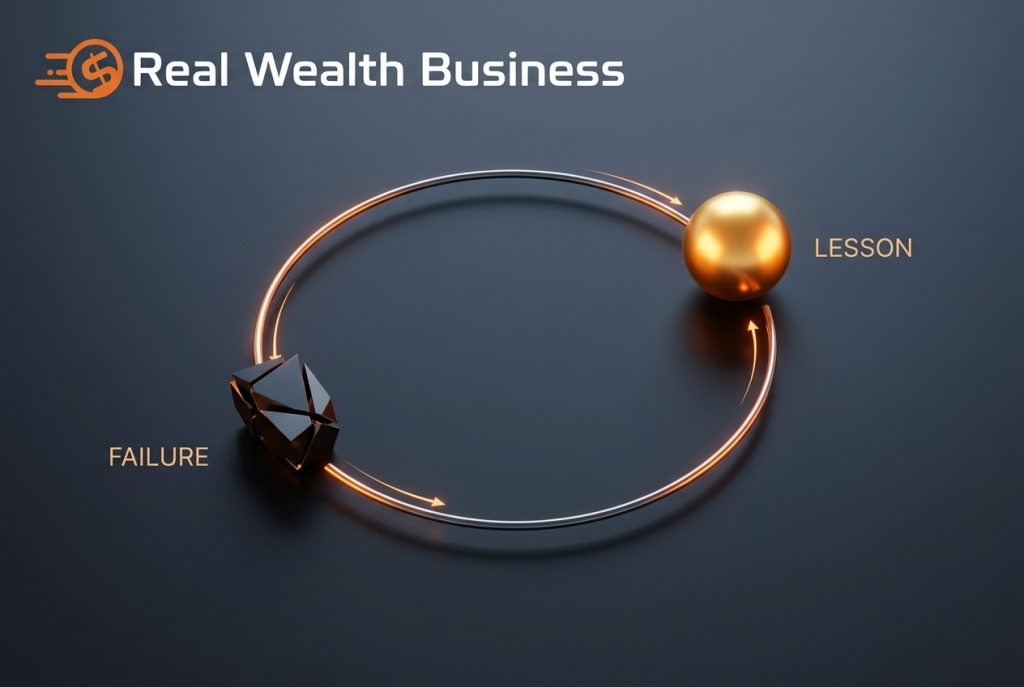
What Musk did differently wasn’t avoiding failure. It was compressing the distance between a mistake and the lesson extracted from it.
This is often summarised as “fail faster,” and as Meritshot’s deep dive into the philosophy explains, the phrase is frequently misunderstood as an endorsement of recklessness.
It isn’t.
It’s a discipline for shortening feedback loops: take a bounded action, observe what actually happens, extract the lesson with precision, and move again – rather than spending months theorizing about a problem you could learn far more about by simply testing it.
There’s real science behind why this works. Stanford psychologist Carol Dweck’s research on growth mindset found that people who treat setbacks as feedback about their current approach – rather than as verdicts on their ability – perform better over time, specifically because they stay engaged with the problem longer.
Separately, learning researchers Robert and Elizabeth Bjork identified what they call “desirable difficulties”: attempting something before you feel fully ready, failing at it, and then receiving the correct answer produces stronger, more durable learning than studying the right answer first.
Failure triggers a prediction error inside your brain. Your brain uses this neural signal to update its model of the world.
SpaceX’s early history is essentially this science, applied under existential financial pressure. Every failed Falcon 1 launch produced a specific, analyzable defect.
Engineers didn’t treat the explosions as evidence the whole approach was wrong; they treated each one as isolated, correctable information.
That distinction – failure as a data point versus failure as a verdict – is the entire Elon Musk business strategy compressed into one sentence.
What This Actually Means For Entrepreneurs
If you’re building something right now, the SpaceX story isn’t useful as inspiration porn. It’s useful as an operating manual, and it breaks down into a few concrete practices.
Treat Every Failure As A Specific, Isolated Problem, Not A Referendum On The Whole Plan
SpaceX’s engineers didn’t ask “should we still be building rockets?” after each failure. They asked, “what specifically went wrong, and what does that tell us to change?”
Vague self-criticism after a setback (“this isn’t working”) is far less useful than a precise diagnosis (“the fuel line failed under X condition”).
Fund Your Own Runway For As Long As You Can
Musk invested his own money into SpaceX. This decision bought the company crucial time. Three straight failures spooked outside investors. They would not have granted that extra time.
You do not need $100 million to use this lesson. A self-funded runway buys you absolute freedom. It allows you to iterate on your own timeline. You never have to follow someone else’s schedule.
Keep Your Cost Base Low Enough That Another Attempt Is Still Possible
SpaceX’s decision to manufacture components in-house rather than outsourcing wasn’t just about cost efficiency; it was about survivability. Lean operations mean a failure doesn’t have to be the last one you can afford.
Actively Seek Out The Criticism You’d Rather Not Hear
Musk has said he doesn’t want to know what people like about a product – he wants to know what they don’t like, because that’s the information that actually improves it. Build a habit of asking for the uncomfortable feedback, not just the encouraging kind.
Set A Real Deadline For The Next Attempt
An experiment without an endpoint isn’t an experiment – it’s indefinite planning dressed up as action.
SpaceX committed to a fourth launch attempt on a fixed timeline. They chose this path despite dwindling resources. They refused to let the program drift indefinitely. Furthermore, the team did not waste time trying to eliminate every remaining risk.
Separate Your Identity From Any Single Outcome
This is the hardest one, and arguably the most important. Musk has openly described how close he came to breaking down under the weight of 2008.
He did not pretend the crisis was easy. Instead, he kept working on the problem. He pushed forward despite the immense difficulty.
Do not tie your confidence to individual results. Constant emotional swings drain your energy. You need that energy to run the next experiment.
How Real Wealth Business Helps You Build Sustainable Growth
Real Wealth Business provides the exact insights you need to start, sustain, and grow your business.
We break down extraordinary journeys – like Elon Musk’s 2008 turnaround – into actionable steps for real-world owners facing tight constraints.
Here is how we help you master these frameworks:
- Expert Strategy Resources: Access research-backed business strategy and leadership analysis. We synthesize these curated tools to inform practical decisions, not just inspire.
- Actionable Scaling Guidance: Get structured, evidence-grounded content on critical growth decisions. Master your hiring, cash flow management, and product strategy.
- Better Decision-Making: Build a faster, disciplined process to turn your own business failures into usable data.
The Point Of The Photograph
The photo of Musk near the wrecked Falcon 1 does not show a fearless leader. Instead, it teaches us a lesson because it shows a terrified man. By his own admission, Musk nearly hit his breaking point. Yet, he still authorized the next launch attempt.
SpaceX did not survive 2008 through raw risk tolerance. Instead, the company possessed a faster, disciplined process. They turned failure into usable information much faster than their competitors.
That’s the actual Elon Musk business strategy hiding inside the mythology. Not fearlessness. Process. And it’s a process any entrepreneur can build into their own company, long before they have a rocket – or a fortune – on the line.