































Let’s cut right to the chase: if you’ve ever found yourself wondering about the difference between an Ethernet cable vs LAN cable while planning your office network, you’re not alone. It’s the classic tech industry tale of a square and a rectangle.
All Ethernet cables are LAN cables, but not all LAN cables are created equal. This isn’t just semantics; it’s the foundational knowledge for any IT manager looking to build a network that won’t throw a tantrum in two years when everyone’s uploading 8K video memes and the CEO wants a VR meeting room.
Future-proofing an office isn’t about having a crystal ball. It’s about making smart, scalable choices today that prevent costly overhauls later. And it all starts with the simplest part of your setup: the cables in your walls and under your desks.
The Great Cable Confusion: Settling The Name Game
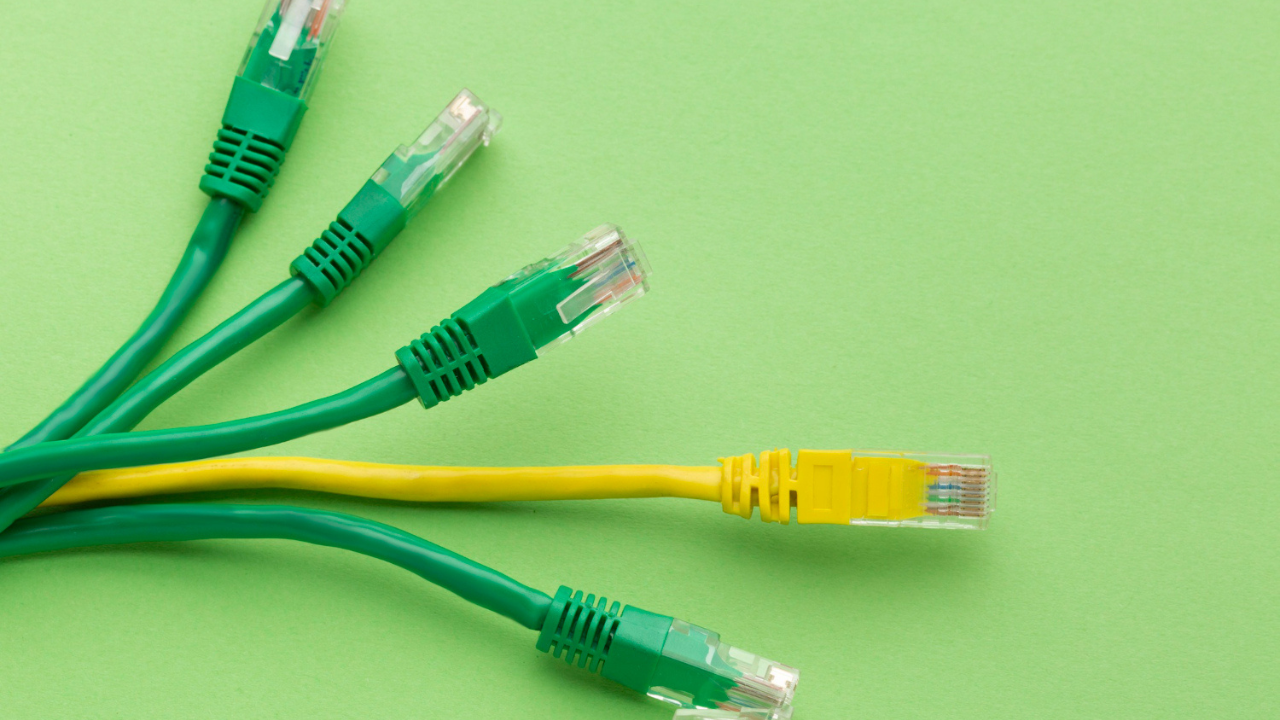
First things first, let’s demystify the terminology. “LAN cable” is a broad term for any cable linking devices in a local network. “Ethernet cable,” however, is more specific. It refers to twisted-pair cables that meet IEEE standards for speed and reliability—the ones with familiar RJ45 connectors.
In practice, when people say “LAN cable,” they usually mean “Ethernet cable.” The real difference lies in the category printed on the cable’s sheath. That’s what determines whether your network is ready for what’s next.
Beyond The Buzzwords: Understanding Cable Categories
This is where the rubber meets the road. You can’t future-proof with yesterday’s technology. You can’t future-proof with outdated tech. Installing old cable is like building a sports car and giving it bicycle tires. Your network will only be as strong as its weakest link.
Here’s the quick and dirty breakdown:
Cat5e: The veteran. It supports speeds up to 1 Gigabit per second (Gbps) at up to 100 MHz bandwidth. It’s fine for basic, current-day operations but is absolutely not a candidate for a new, scalable installation.
Cat6: A solid step up. It can handle 1 Gbps up to 100 meters, but its party trick is supporting 10 Gbps at shorter distances (up to 55 meters). It operates at up to 250 MHz. This is a decent minimum standard for many offices today, but it has its limitations for long-term, high-speed plans.
Cat6A: The “A” stands for “Augmented,” and it’s a game-changer. This is the gold standard for new office builds and major renovations. Cat6A supports 10 Gbps speeds at the full 100-meter distance and boasts a massive 500 MHz bandwidth. It’s also typically better shielded, which means less crosstalk and interference in electrically noisy environments.
Cat7/Cat8: These are the hyper-specialized Ferraris of the cable world. Cat8 is designed for data center environments, supporting 25 Gbps and even 40 Gbps at very short distances (around 30 meters). For a general office environment, this is serious overkill and comes with a much higher cost for both cable and compatible hardware. For 99% of offices, Cat6A is the sweet spot.
For a scalable office network, choose Cat6A. The slightly higher cost is trivial compared to rewiring later.
More Than Just Cable: The Pillars Of A Future-Proof Network
Picking the right cable is the first and most crucial step, but it’s not the only one. A network is an ecosystem, and every part needs to be on the same page.
1. Terminate With Care And Quality:
Even the best cable underperforms if poorly terminated. Use high-quality jacks and patch panels, and test every connection. And for safety sake, make sure your installers are certified and test every single run with a professional cable certifier, not just a simple continuity tester. This verifies that each connection actually performs at Cat6A specifications.
2. Choose “Smart” Switches:
Your shiny new Cat6A cables need to plug into something. Managed switches are non-negotiable for a professional setup. They provide control, security, and the ability to monitor network traffic, segment networks (VLANs), and prioritize critical applications (Quality of Service).
Ensure your core and edge switches have multi-gigabit (Mgig) ports. These ports can automatically negotiate at speeds like 1 Gbps, 2.5 Gbps, 5 Gbps, and 10 Gbps, providing a seamless upgrade path as you introduce faster devices without having to replace the switch.
3. Plan For Wireless (Yes, Really):
The wired backbone is what makes great Wi-Fi possible. Every wireless access point (AP), especially those supporting Wi-Fi 6 and the upcoming Wi-Fi 6E and Wi-Fi 7, needs a high-speed wired connection.
A top-tier Wi-Fi 6 AP can easily exceed 1 Gbps of traffic. Each AP should be connected back to the switch with your future-proof Cat6A cable to ensure it’s not bottlenecked. Think of cabling as the foundation that supports both wired and wireless success.
4. Conduit Is Your Best Friend:
True future-proofing admits that we can’t predict everything. One of the smartest things an IT manager can do is install conduit (smurf tube) in the walls and ceilings during construction or renovation.
This plastic tubing provides a protected pathway for your current cables and, most importantly, makes it incredibly easy to pull new cables in the future when standards inevitably change again. It’s a cheap insurance policy that pays infinite dividends.
Build It Smart, Then Forget It
Building a network isn’t the most glamorous part of an IT manager’s job, but it’s arguably the most important. You’re building the central nervous system of the entire company.
By making informed choices today—specifying Cat6A cable, insisting on certified installation, investing in quality supporting gear, and laying physical conduit for the unknown—you’re not just solving for today.
You’re creating an infrastructure that is silent, resilient, and powerful. You’re building a network that the people working at those desks will never have to think about. It will just work. They’ll seamlessly adopt new technologies, handle massive files without a hiccup, and collaborate in ways we haven’t even imagined yet.
And you? You’ll be the unsung hero who built it right the first time, avoiding frantic midnight upgrades and justifying the budget for the next big innovation instead of just playing catch-up. Now that’s a future worth proofing.
Read Also: