































In the dynamic landscape of modern business, operational excellence and sustained success hinge on more than just innovative products or shrewd market strategies. At the very core lies an often-underestimated yet profoundly powerful force: workplace culture.
Its influence shapes everything from daily interactions to long-term strategic outcomes. The staggering reality reveals that unengaged employees cost U.S. companies an estimated $1.9 trillion in lost productivity in 2023, while highly engaged organizations boast 23% higher profitability than their competitors. This compelling evidence underscores that a vibrant culture, built on shared values and dedicated to employee fulfillment, directly translates into operational excellence.
This extensive guide delves into the intricate relationship between workplace culture and efficiency, illuminating how a thriving environment can significantly boost engagement, retention, and ultimately, profitability. We will explore the direct links, identify the characteristics of a strong culture, and expose the detrimental signs of a toxic one. Understanding how to align a company’s values with its operational practices, including through robust workplace culture ESG initiatives, is no longer optional but a strategic imperative for long-term success. Join us as we uncover actionable strategies for leaders to cultivate an environment that fuels productivity and drives enduring business growth.
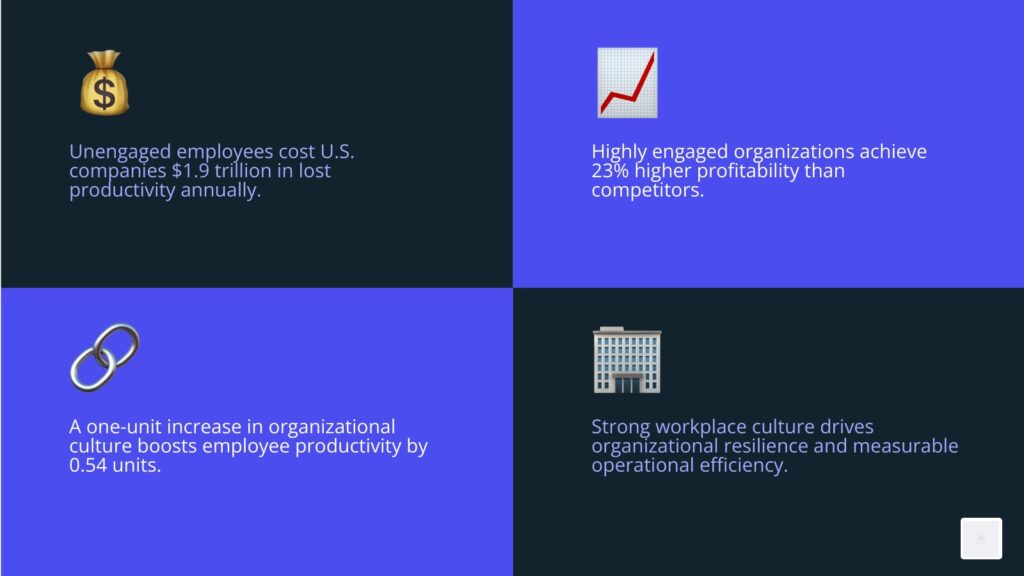
The connection between a company’s culture and its operational efficiency is not merely anecdotal; it is a profound, data-backed relationship that drives organizational resilience and employee engagement. Research consistently demonstrates that a positive organizational culture significantly boosts employee productivity. One academic study revealed a compelling link, showing that a one-unit increase in organizational culture leads to a 0.54-unit increase in employee productivity. This isn’t just about feeling good at work; it’s about measurable output and tangible results.
When we talk about workplace culture, we’re referring to the collective attitudes, beliefs, and perceptions that define an organization’s principles and practices. It’s the unspoken code of conduct, the shared values that guide decision-making, and the overall atmosphere that employees experience daily. A strong culture fosters an environment where individuals feel valued, understood, and motivated, directly impacting their ability to perform at their best. Companies that actively cultivate a healthy culture often find it easier to implement and sustain initiatives, including sophisticated programs like workplace culture ESG initiatives, which further enhance their reputation and operational integrity.
Defining the Core Traits of Workplace Culture and Efficiency
A strong, positive workplace culture that genuinely drives efficiency is characterized by several key elements. At its foundation is psychological safety, where employees feel comfortable taking risks, voicing concerns, and admitting mistakes without fear of retribution. This fosters an environment of continuous learning and innovation.
Mission alignment is equally crucial. When employees clearly understand and connect with the company’s purpose and vision, they are more engaged. In fact, employees are eight times more likely to feel engaged when the culture is strong compared to when it’s weak. This alignment translates into focused effort and shared commitment towards common goals.
Transparency in communication from leadership builds trust and reduces uncertainty, allowing teams to react more swiftly and effectively to challenges. Coupled with accountability, where individuals and teams take ownership of their responsibilities and outcomes, it creates a high-performance environment. Shared beliefs and values act as a compass, guiding behavior and decision-making across all levels of the organization, ensuring consistency and cohesion.
Finally, clear goal clarity ensures everyone understands what needs to be achieved and how their individual contributions fit into the larger picture, minimizing wasted effort and maximizing collective impact. These traits collectively create a synergistic environment where efficiency is a natural byproduct of a thriving culture.
Identifying and Overcoming Toxic Cultural Barriers
Conversely, a toxic workplace culture can be a silent killer of efficiency and productivity, leading to significant negative consequences for both employees and business outcomes. One of the most prevalent signs is widespread burnout, where employees feel exhausted, cynical, and ineffective due to excessive demands and lack of support. This often leads to increased absenteeism and high turnover rates. Statistics show that the cost to replace an employee can be as high as 60% of their annual salary, making high turnover an incredibly expensive problem.
Other indicators of a toxic environment include disorganized training and a general lack of effective onboarding, which can cause new hires to feel lost and disengaged from the start. A staggering 60% of workers reported leaving a job within 90 days due to disorganized training or poor onboarding, highlighting its critical role. A pervasive lack of leadership or ineffective leadership is another major culprit; 42% of surveyed workers cited this as a reason for leaving a job within 90 days.
Incivility—manifesting as disrespect, rude behavior, or a lack of empathy—erodes trust and collaboration. Uneven accountability, where some employees are held to different standards than others, breeds resentment and unfairness. Finally, a culture that offers no clear paths for growth and development leads to stagnation and disengagement, as employees see no future within the organization. Overcoming these barriers requires a conscious, sustained effort from leadership to identify the root causes, implement corrective measures, and foster an environment of respect, fairness, and opportunity.
Measuring the Impact of Culture on Operational Output
To truly understand the value of workplace culture, organizations must be able to measure its impact on key operational outputs. This involves looking beyond anecdotal evidence and delving into concrete metrics. The disparities between organizations with strong versus weak cultures are stark:
Comparison of High-Engagement vs. Low-Engagement Organizations
Metric High-Engagement Organizations Low-Engagement Organizations Profitability 23% higher Significantly lower Median Pre-Tax Margin 15 times higher Significantly lower Productivity 17% higher Significantly lower Turnover Rate Nearly 60% less Significantly higher Customer Loyalty 10% higher Significantly lower Sales Productivity 18% increase Significantly lower Employee Engagement 8x more likely to feel engaged Significantly less engaged Employee Retention (12-mo) 12x less likely to leave Significantly more likely to leave These metrics, derived from various studies including Gallup, clearly illustrate the significant return on investment (ROI) for cultivating a positive culture. Organizations with high employee engagement, a direct outcome of strong culture, experience a median pre-tax margin fifteen times higher than companies with low engagement. They also see a 10% higher customer loyalty and an 18% increase in sales productivity. Furthermore, workers in high engagement organizations are 12 times less likely to leave their company within a 12-month period.
Tools like pulse surveys provide regular snapshots of employee sentiment, allowing leaders to track changes and identify areas for improvement. Frameworks such as the Organizational Culture Assessment Instrument (OCAI) can help classify and understand the dominant culture types within an organization. By regularly assessing these factors and correlating them with business outcomes, companies can make data-driven decisions to refine their cultural strategies and maximize their operational output. This continuous measurement and adaptation are vital for maintaining a competitive edge and fostering a truly efficient workplace.
Actionable Strategies to Transform Your Organizational Environment
Transforming an organizational environment from one that merely exists to one that thrives as a strategic asset requires deliberate and continuous effort. It’s about recognizing that culture isn’t a static entity but a dynamic force that needs nurturing and strategic guidance. Employees widely acknowledge this, with 77% stating that workplace culture directly impacts their ability to do their best work. When culture is strong, it acts as a powerful magnet for talent and a retention mechanism, making employees 12 times less likely to leave their company within a 12-month period. This demonstrates how investing in professional development and fostering cultural maturity can yield significant returns.
Building a culture that boosts efficiency demands a holistic approach, encompassing everything from initial employee interactions to ongoing leadership practices and wellness initiatives. It’s about embedding values and behaviors that support high performance and employee well-being at every level.
Optimizing Onboarding and Communication for Workplace Culture and Efficiency
The initial experience an employee has with an organization sets the tone for their entire tenure. Optimizing the onboarding process is paramount, as it’s the first opportunity to immerse new hires in the company’s culture, values, and mission. It’s not just a single event but a journey that can last for months. Research indicates that onboarding should be viewed as a long-term process, ideally extending 6-7 months to fully settle new hires. A well-structured onboarding can lead to an 80% retention boost, while disorganized training is a significant factor in the 60% of workers who leave a job within 90 days. By making onboarding comprehensive and culturally immersive, organizations can prevent this costly early turnover.
Beyond onboarding, fostering open communication and trust is critical for a high-efficiency culture. This involves creating channels for regular, transparent dialogue, such as frequent team meetings, one-on-one check-ins, and anonymous feedback mechanisms. When communication flows freely, silos break down, problems are identified and resolved faster, and innovation is encouraged. Leaders should proactively solicit feedback and demonstrate that it is valued and acted upon.
Recognition and feedback systems also play a vital role. Platforms like Bonusly or Kudos can facilitate peer-to-peer recognition, celebrating achievements big and small. This consistent acknowledgment of contributions boosts morale and reinforces desired behaviors. For organizations looking to cultivate a highly effective and dedicated team efficiency culture, integrating these communication and recognition strategies is essential. These practices not only enhance individual performance but also strengthen team cohesion, leading to better collaboration and overall operational efficiency.
Leadership’s Role in Sustaining Long-Term Performance
Leadership is the primary architect and custodian of an organization’s culture. Leaders don’t just set the vision; they embody it through their actions, decisions, and interactions. This concept of leading by example is fundamental. If leaders preach transparency but practice opacity, the culture will inevitably suffer. The significant impact of leadership is underscored by the fact that 42% of workers who left a job within 90 days cited a lack of leadership as their main reason.
Effective leaders cultivate a positive culture by consistently demonstrating the values they wish to see replicated throughout the organization. This includes visionary communication, articulating a clear and compelling future that inspires employees and aligns their efforts. It also means fostering inclusivity, ensuring every voice is heard and valued, which enriches perspectives and drives innovation.
Building trust is another cornerstone of leadership’s role. Trust is earned through consistency, integrity, and genuine care for employees’ well-being. When employees trust their leaders, they are more willing to take risks, collaborate, and commit to organizational goals. Leaders also shape culture through their decision-making, ensuring that choices reflect the company’s stated values and strategic objectives. By actively managing and nurturing these aspects, leaders can ensure strategic alignment across all levels, translating cultural health into sustained long-term performance and efficiency.
Fostering Wellness and Recognition to Prevent Burnout
A truly efficient workplace understands that employee well-being is not a perk, but a prerequisite for sustained high performance. Fostering wellness and preventing burnout are crucial strategies for maintaining a healthy and productive workforce. This begins with promoting work-life balance, encouraging employees to disconnect and recharge. Leaders can set the example by respecting boundaries, offering flexible scheduling options, and advocating for adequate rest. Mental health support and resources are also vital components of a comprehensive wellness program.
Recognition and gratitude play a powerful role in boosting morale and engagement. Acknowledging employees’ hard work and contributions, whether through formal awards, public shout-outs, or personal thank-you notes, reinforces their value and motivates them to continue performing at a high level. High employee engagement, often fueled by effective recognition, has been linked to an 18% increase in sales productivity, directly impacting the bottom line.
Implementing diverse employee rewards programs, which could range from gift cards and experiences to professional development opportunities, demonstrates that the organization values its people. This sense of being valued contributes to a feeling of generosity within the workplace, where employees are more willing to go the extra mile for their colleagues and the company. By prioritizing these initiatives, organizations create an environment where employees feel supported, appreciated, and energized, significantly reducing the risk of burnout and ensuring that the workforce remains engaged, productive, and efficient in the long term.