
























































































What Are Three Common Causes Of Small Business Failure?
by Piyasa Mukhopadhyay Small Business 15 July 2025

Entrepreneurship is exhilarating but comes with many challenges. Entrepreneurs often venture into establishing their businesses with grand ambitions, but they typically do not survive for more than five years in most cases.
The question that comes to mind here is: what are three key reasons why small businesses fail? Avoiding them is the key to knowing these reasons.
This article looks at the number one reason why small businesses fail, cross-checks failure rates, and shows how something as simple as location can make or break a business.
Whether you are preparing to begin a new business or currently have one, this is worth reading to continue to be successful in business.
How Many Small Businesses Fail

Before we discuss the reasons in particular, let’s check the facts. Research shows that approximately 20% of small businesses close in the first year, and about 50% last five years.
By the 10-year mark, approximately 65% of businesses have closed. These statistics are daunting, but they also help to show the reasons why it is useful to know the most common reasons small businesses fail.
These numbers are not statistics—they are real people, hopes, investments, and communities. It would be worthwhile to understand why these failures occur to anyone willing to start or run a successful and lasting business.
Why Businesses Fail at Entrepreneurship
Entering into business is all about taking risks, but some risks can be mitigated. Companies do not go down overnight.
It typically occurs due to details left unattended, poor planning, or failure to recognize critical market changes. Let us examine some key reasons:
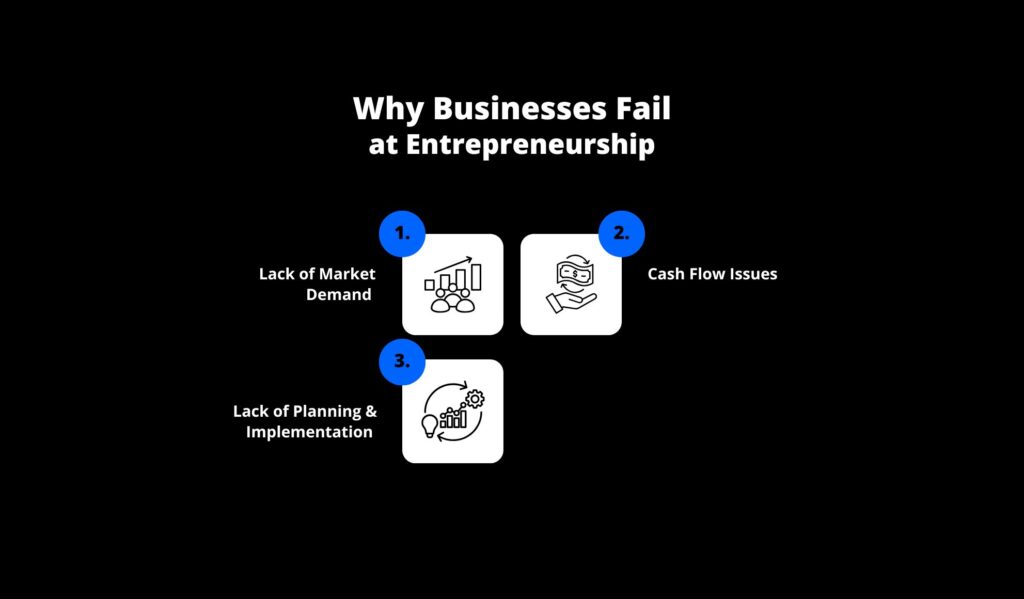
Lack of Market Demand
One of the primary reasons startups fail is that they produce products or services that people do not want.
Having a good idea is not always a good business. Business owners may love their ideas but neglect to verify whether there is actually demand in the marketplace.
This is usually the case when companies fail to conduct market research. Your business is just making a guess! That too, without understanding
- Who your buyers are,
- What their issues are, or
- How much would they pay for your solution?
Cash Flow Issues
You might assume low profits to be the biggest issue for small businesses, but cash flow will probably be the killer that takes them down.
A company can be profitable on paper but still not have enough cash to pay the suppliers, staff, or rent.
Bad money management, slow billing, or failure to save during lean months can lead to cash issues for businesses. Effective management of cash flows is necessary to ride out the ups and downs of business.
Lack of Planning and Implementation
Even when the idea is fantastic and capital is available, bad execution can kill a business. That includes things like
- Weak marketing,
- Low morale staff,
- Weak customer service, and
- Being too rigid.
A business needs good leaders, clear objectives, and the ability to change situations when needed.
This leads us back to our question: what are three of the most common reasons small businesses are not successful? The answer—no market demand, cash flow issues, and poor performance—accounts for many business failures.
What proportion of small businesses shut down within the first 5 years?
As noted above, about 50% of small businesses will not make it through the first five years. Half of all new ventures fail to survive what is known as the “survival stage.” Why is this period so critical?
In the first five years, a company is still learning. It learns what works, experiences competition, complies with the law, and attempts to grow. It’s years of opportunity and risk. It’s the years when early decisions have long-term implications.
Most companies that survive more than five years have generally done some very crucial things right—they’ve managed money right, actually listened to customers, and were able to adapt quickly when they had to. The 50% that fail fail because they’ve gotten one or more of the critical things about a successful business wrong.
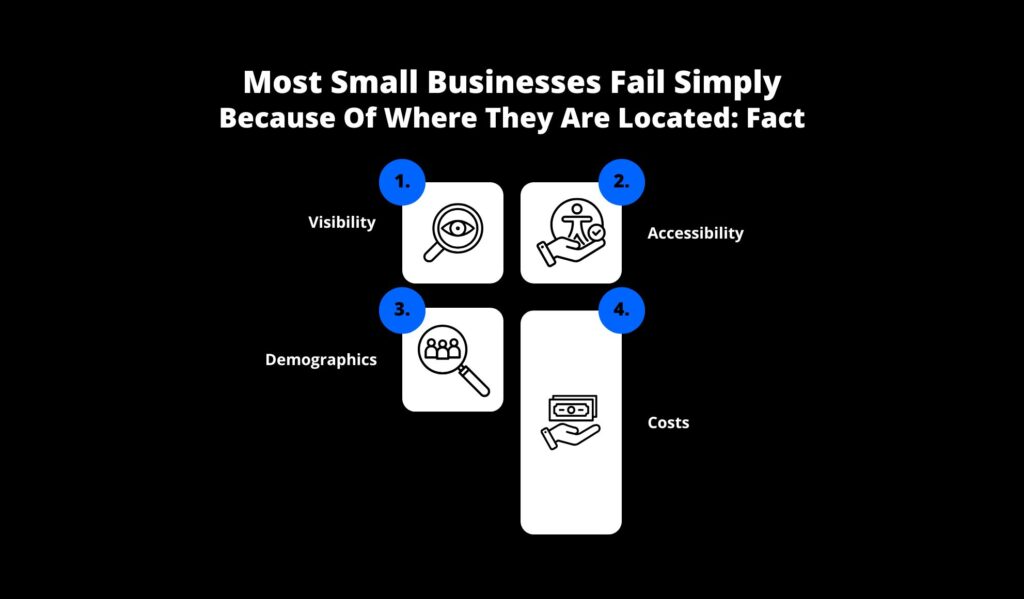
Most Small Businesses Fail Simply Because Of Where They Are Located: Fact!
Believe it or not, even in today’s world, where a business is situated matters—at least to stores, restaurants, and service companies. A fantastic business concept can fail if it is positioned in a low-traffic area, out of the way, or with too much competition.
Think of opening a charming coffee shop, but it is in an alley with no sign and parking. Even if you have excellent coffee, you won’t be able to get anyone to go in. Or a high-end clothing boutique in an area where customers are more concerned with low prices. In either case, location damages the business.
Here’s why location is such a big deal:
- Visibility: If others can’t see your company, they won’t visit.
- Accessibility: If customers can’t park or walk to you conveniently, they’ll go elsewhere.
- Demographics: Others you’d like to reach might not reside or shop in your neighborhood.
- Costs: Quality premises may be expensive, and alone, the rent may be ruinous to a small business unless augmented by sales.
So, although it may be a cliché, a lot of small businesses fail just because of where they are situated, and it is an easily avoided mistake by doing some research and taking action.
The Entrepreneurial Mindset and Flexibility Role
Other than glaring issues like finances and geography, the attitude of people is important for a company to thrive. Entrepreneurs must be firm but not obstinate. They must understand when to stick to their goals and when to change direction.
Most business owners become so invested in their initial idea that they overlook indications of a needed shift. Creativity and problem-solving can be what keeps the growth process going rather than closing up shop.
The most important characteristics that ensure business survival are:
- Flexibility: Being open to change with market demands.
- Resilience is when a person rebounds after encountering challenges.
- Strategic Thinking: Future planning using the support of real-time data.
Learn About the Most Common Reasons for Failing
So by now, I assume you have understood what are three common causes of small business failure!
See, building a business is always a risk—but by sidestepping pitfalls, you increase your odds of long-term success. Here’s how:
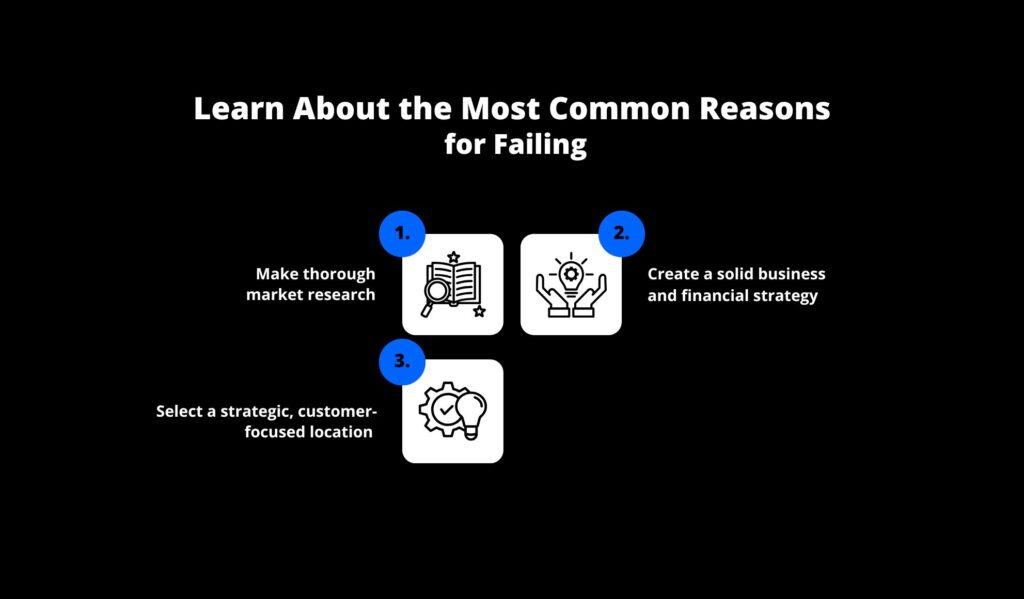
Make thorough market research.
You must ensure that there is a genuine demand for your service or product. You can talk to the prospective clients and research to understand your competitors.
Furthermore, I would also suggest that you test your concept thoroughly before you even decide to invest a significant amount.
Create a solid business and financial strategy.
Don’t assume! That’s the biggest mistake you can make! Rather, I would like you to put everything on paper. This can include:
- Your costs
- Projected revenue
- Cash flow plan
- Growth ideas
Trust me! Once you have a clear plan, it will be easier for you to make better decisions.
Select a strategic, customer-focused location
Your site needs to be compatible with all the habits of your target market. You can think about the traffic patterns, better visibility, parking and surrounding businesses.
Continuous improvement by applying data and feedback.
Be adaptable. Listen to customers, see what’s successful, and be willing to adjust if something isn’t delivering good results.
Planning to fail is not planning. However, if you plan and anticipate the most common problems, your small business will likely flourish.
Also Read







Related